Scout: AI That Finds Human Experts
Some questions can't be answered by a model or a search engine — they live in someone's head. Scout is an agentic pipeline that finds that someone, fast.
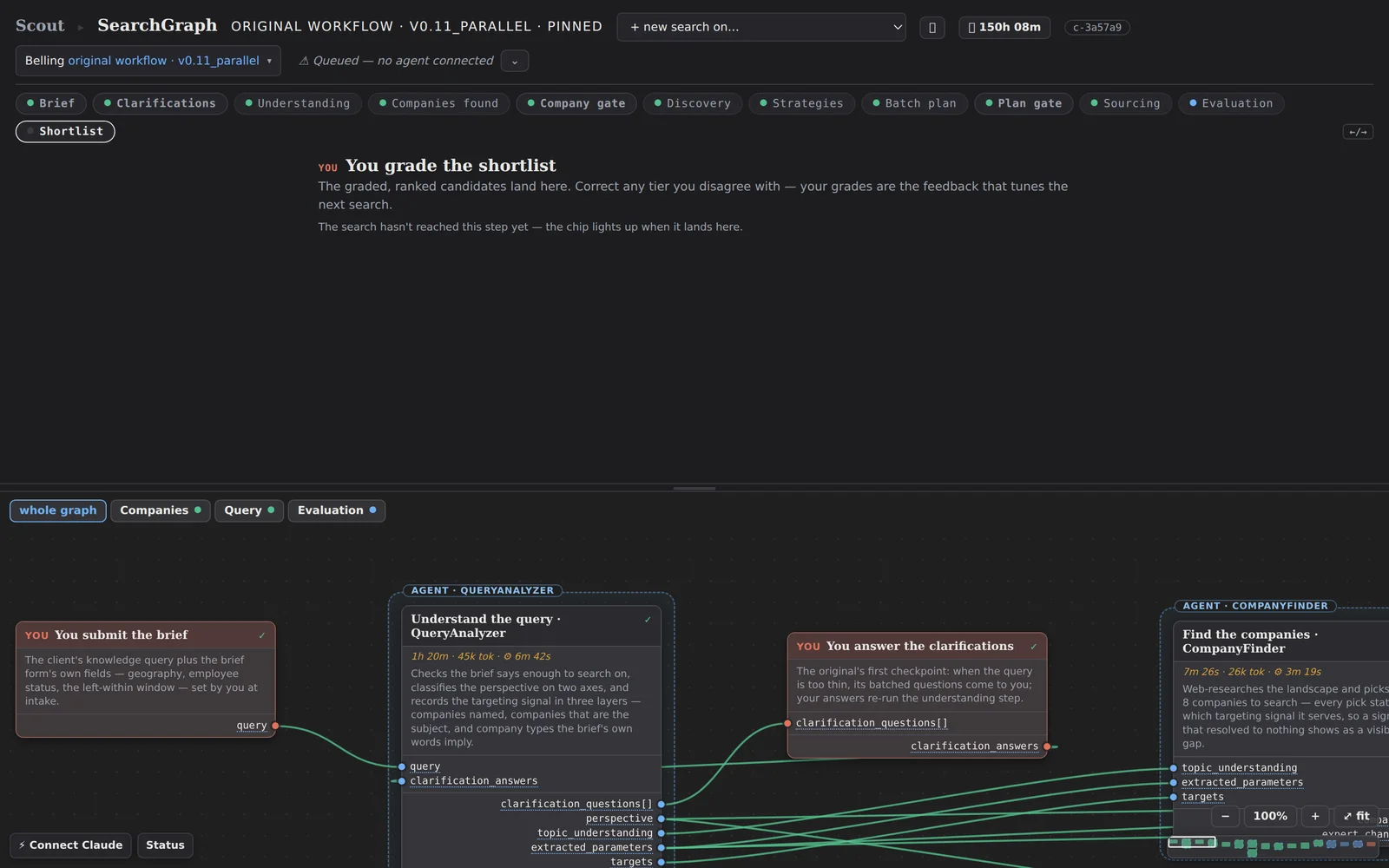
TL;DR — During a technical-cofounder trial with an expert-network startup, I built Scout: an agent-driven pipeline that turns a client's knowledge question into a stack-ranked shortlist of human experts. It compresses an associate's multi-hour sourcing grind into a ~30-minute auditable run costing a few dollars — and it sourced a real expert call that was sold to a real client.
Stack: Claude agents (in-session, no LLM API calls), Python stdlib app, Crustdata + Exa people-data APIs, file-based state, Linear
Some questions still need a human
For all the hype about AI replacing knowledge work, there is a class of questions no model can answer: Why hasn't this consumer brand been acquired yet? How does this operator actually run VIP retention? The answer lives in the head of someone who was in the room. Expert networks sell exactly that — they find that person and put them on a paid call with a hedge fund or PE firm doing diligence. One sold call grosses $400–500.
The product is not information. The product is a shortlist of the right humans.
The bottleneck is sourcing speed
Here is the brutal part of that business: the client sends the same brief to three or four competing networks and books calls with whoever delivers first. Outreach response is the slow, uncontrollable step — so to win, you need to go from brief to outreach within the first two or three hours. The funnel is wide: a search surfaces 500–600 profiles, maybe 30–40 are truly relevant, and two or three will actually get back to you. Missing a strong candidate is expensive; a noisy profile in the pool is cheap.
Done by hand, sourcing is LinkedIn archaeology: research the industry, find anchor companies, reverse-engineer job titles and keywords from profiles, build boolean searches company by company, then eyeball the results — with a working rule of "if a search returns under ~400 profiles, review all of them manually."
What Scout does
Scout replicates that associate workflow as a staged agent pipeline: understand the query → propose target companies → resolve entities and build an evidence-cited vocabulary → construct per-company searches → pull candidates from the data vendor → screen every profile against a rubric → deliver a tiered shortlist (Best / Great / Good / Average / Screened out), each with cited reasoning.
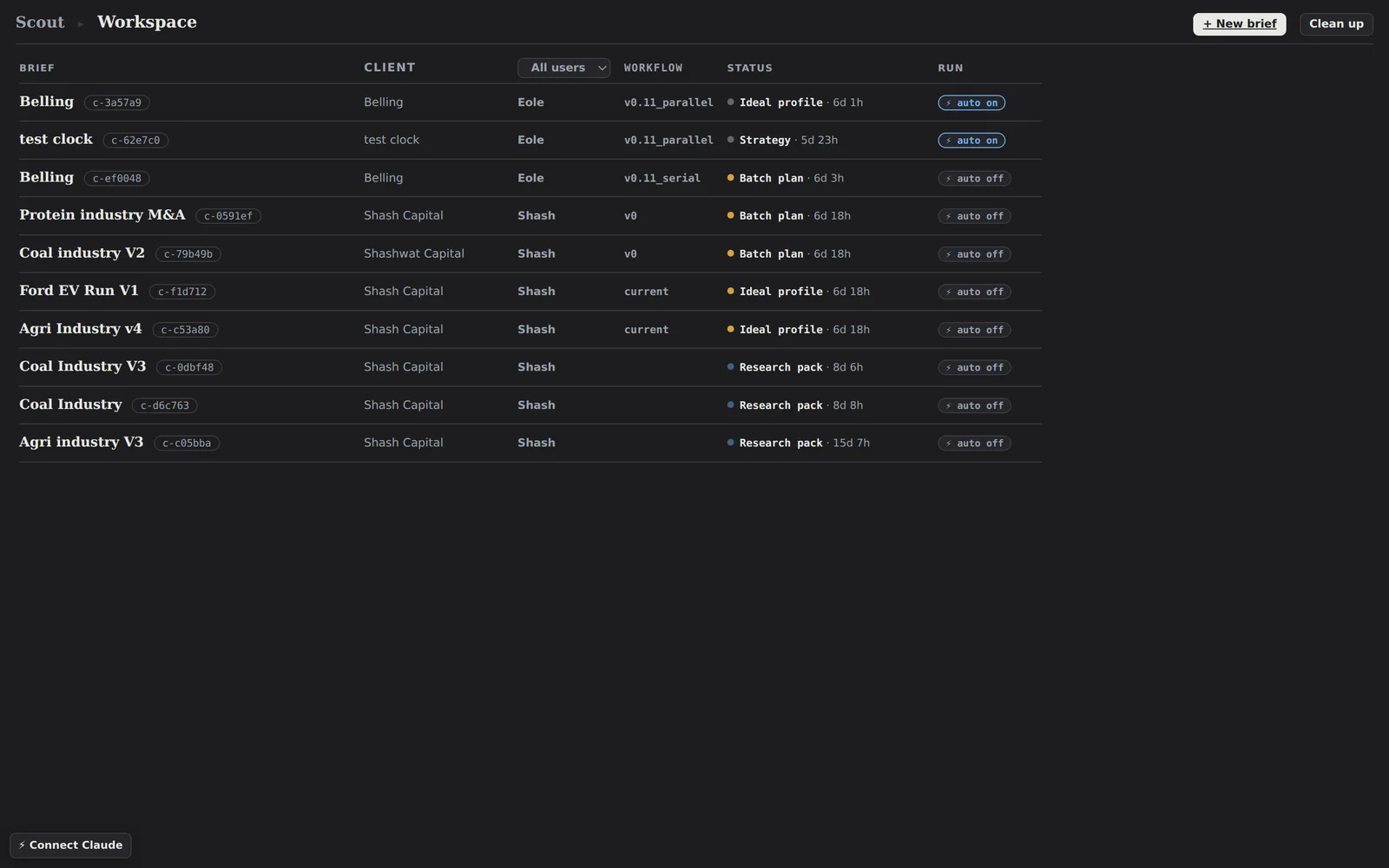
Every brief is a case; every search is a pinned, replayable run.
A full run takes 25–35 minutes and costs pennies in vendor credits — against $400–500 gross per sold call, search cost is a rounding error. The existence proof came early: a call sold to a real client from a shortlist sourced entirely by the pipeline.
What the hard parts taught me
The old heuristics were human constraints. The ~400-result review cap exists because that's what a person can eyeball in 30 minutes. An LLM screener costs tokens, not hours — so the right move flips: pull wide, screen everything, and treat over-filtering as the cardinal sin, because a missed expert is unrecoverable revenue.
Early mistakes compound. The pipeline is sequential: a wrong assumption at the first stage poisons every stage after it, and some of those stages spend real money. One run researched "global" for a Europe-only brief; another invented target companies mid-pipeline; another read a brief asking for bankers and proposed ten operating companies and zero banks. Each failure became structure: a clarification gate before research starts, a company gate after which the set freezes (machine-enforced), a credit gate before vendor spend.
Trust requires citations. The domain expert has to audit decisions they didn't make. So every search keyword cites the profiles it was harvested from, vocabulary is selected from cited evidence rather than generated fresh (identical briefs used to yield different searches), and the rule everywhere is null over guess.

The run trace: every stage output, token count, and gate approval on the record.
Why not just use Claude Code?
Claude Code is the harness Scout runs on — but a chat session alone couldn't be the product:
- ~8 human judgment calls per run. Wrong assumptions cost time and money, and in this business time is the business. The gates are load-bearing, and the agent is capability-fenced so it physically cannot approve its own spend.
- Steps cost real money. Vendor pulls are metered; spend needs an estimate and an approval, not an agent's enthusiasm.
- Consistency beats brilliance. Every run pins the exact methodology version it ran on, so the founder's grading of run N is an apples-to-apples experiment against run N+1. Baseline runs even execute through a "blind executor" — a tool-starved subagent that can't see the repo — so a context-rich session can't contaminate the comparison.
- People-data stays local. No LLM API calls at all: all judgment runs in-session on a subscription, at zero marginal token cost, and transcripts and profiles never leave the machine.
Where this goes
Today the loop is: human takes a complex question, AI finds the humans who can answer it. The interesting future is the inverted loop — an agent working through a complex task recognizes that a sub-question exceeds what any document can answer, sources the right human expert, and proactively asks them. Expert sourcing stops being a business process and becomes a tool call: humans in the loop not as supervisors, but as the scarcest, highest-value data source an agentic system can query.
LLM · agents · expert networks